浙侨英频 ?RCEP set to boost regional, global growth
发布时间:2022-01-04
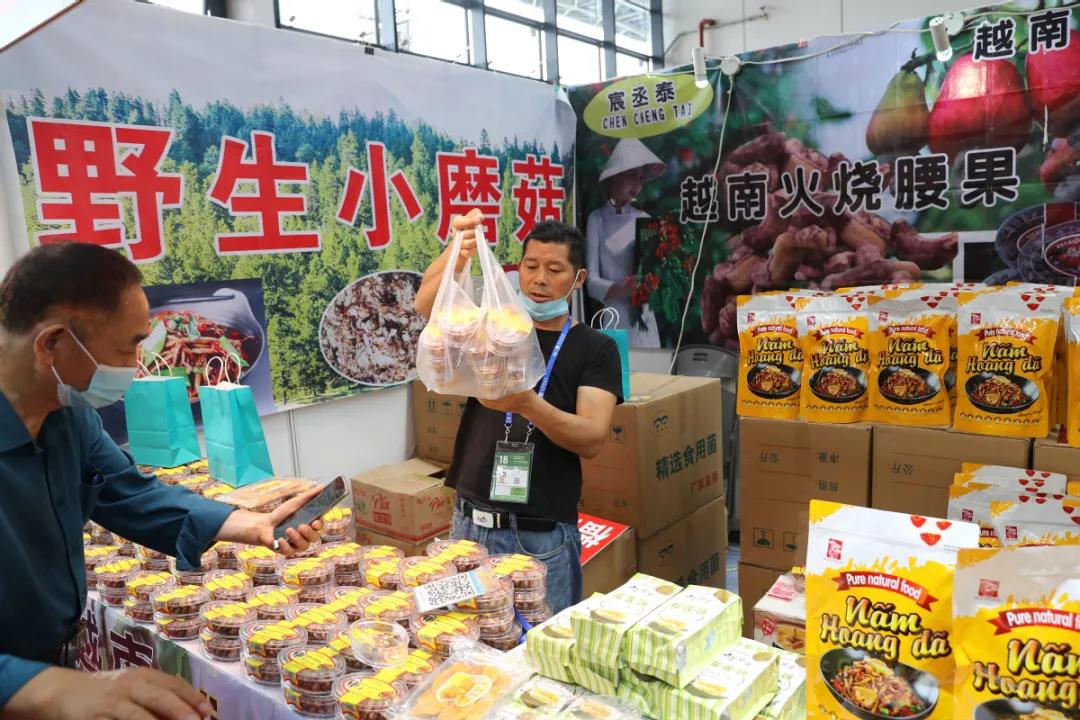
A customer (left) pays for cashews produced in Vietnam at the 18th China-ASEAN Expo in Nanning, the Guangxi Zhuang autonomous region, on Sept 13. [Photo by Wang ZhuangfeiChina Daily]
Deal could make area a haven for some of the world's most efficient supply chains
The Regional Comprehensive Economic Partnership agreement, which will take effect on Saturday, is expected to significantly boost the regional and global economies and offer lessons for international cooperation.
The RCEP is a huge, potentially powerful agreement among rich and poor countries that complements each other's strengths, Peter Petri, a professor of international finance at Brandeis University in the United States, told China Daily.
For example, it has favorable rules for the parts and components trade, and these could help developing members benefit from partnering with more advanced countries, making the region a haven for some of the world's most efficient supply chains, he said.
If its potential is realized, the RCEP would create larger markets and innovative, affordable products for the world economy, he added.
Signed in November last year by 15 Asia-Pacific economies — all 10 member states of the Association of Southeast Asian Nations, China, Japan, South Korea, Australia and New Zealand — the agreement has created the world's largest free trade bloc that accounts for about one-third of the global population and gross domestic product.
It will take effect in 10 member states — Brunei, Cambodia, Laos, Singapore, Thailand, Vietnam, China, Japan, New Zealand and Australia — on Jan 1, and for the other five members 60 days after official deposition of ratification, acceptance or approval. South Korea will see it take effect on Feb 1.
According to a recent study by Petri and Michael Plummer, a professor of international economics at Johns Hopkins University in the US, the RCEP is estimated to increase world trade by nearly $500 billion annually by 2030 and raise world incomes by $263 billion annually.
There are several aspects of the agreement that will lead to significant economic effects, even if the RCEP is not as ambitious in scope as, say, the Comprehensive and Progressive Agreement for Trans-Pacific Partnership, Plummer told China Daily.
For example, it will create harmonized, cumulative rules of origin for intra-RCEP trade, which should give a significant boost to regional supply chains, at a time when supply chains are facing headwinds, he said.
The agreement will lower tariffs on about 90 percent of traded commodities and reduce some non-tariff barriers to trade in goods and services, according to Plummer. Importantly, it will create a free-trade area among the Northeast Asian economies of China, Japan and South Korea, giving a particularly strong boost to trade and production in the area of advanced manufacturers, he added.
The study by the two economists, published by the East Asian Economic Review, estimates that the RCEP should increase regional incomes by $245 billion on a permanent basis and create 2.8 million jobs in the region, which Plummer described as a significant boost.
In addition to its salutary effects on global incomes and trade, the RCEP offers an important boost to opening international markets, with very little negative effects on outside economies in the form of trade diversion, said Plummer.
Moreover, the RCEP shows how developed and developing countries can work together to include the interests of countries at all levels of economic development, he said.
This could hold some important lessons for the WTO, which reached an impasse at the Doha Development Agenda to a large extent because it was unable to accommodate the interests of developed and developing economies sufficiently, said Plummer.
Petri also noted that the RCEP's success will depend on how well countries with different systems will work together to make the agreement successful.
If benefits are widely shared and relations are positive, members will implement the agreement fully and may even expand its scope, he said. The RCEP could become a model for cooperation in an unusually diverse economic region.
【背景阅读】
RCEP生效在即 开放合作始终是国际主流
《区域全面经济伙伴关系协定》(RCEP)将于2022年1月1日正式生效。面对世界百年未有之大变局和世纪疫情,这一参与人口最多、成员结构最多元、发展潜力最大的自贸区,将有力拉动国际贸易投资增长,促进全球经济复苏。
近年来,逆全球化和贸易保护主义暗流涌动,经济全球化面临严峻挑战。新冠肺炎疫情导致全球经济增长乏力,国际贸易严重衰退。RCEP成员国共同推动协定如期生效,对外发出反对单边主义和贸易保护主义、支持自由贸易和维护多边贸易体制的强烈信号。
RCEP即将生效再次证明,共谋发展是历史潮流,互利共赢是人心所向。按照协定,已核准成员国之间90%以上的货物贸易将实现零关税,各成员国将大幅削减经贸合作限制,促进商品与要素流通,深化分工合作,提高生产效率。这既是成员国顺应经济发展规律的要求,也是适应国际形势变化的需要。
RCEP即将生效,将进一步提振国际社会携手实现经济复苏的信心与决心。RCEP涵盖关税减免、贸易便利化、服务投资开放等广泛领域,将推动亚太区域加强产业链协作和优化供应链布局,有助于成员间产业链供应链深度融合,促进经济要素自由流动。RCEP一体化大市场的形成,将进一步激发成员国各领域合作潜力,缓解逆全球化和疫情冲击带来的压力,向世界释放共享市场、共同繁荣的互利共赢红利,为自由贸易和多边主义注入全新活力。
中国是非东盟国家中首个正式完成核准程序的成员国,彰显出中国以实际行动推动经济全球化朝着更加开放、包容、普惠、平衡、共赢的方向发展,以坚定的决心维护多边贸易体制、推动区域经济一体化进程。作为成员国中最大的经济体,中国将为RCEP充分释放制度红利提供市场空间和产业体系支撑,为促进全球经济复苏和亚太地区繁荣贡献中国力量。
来源 新华社