浙侨英频 ?Proxy war takes big toll in Ukraine
发布时间:2022-04-12
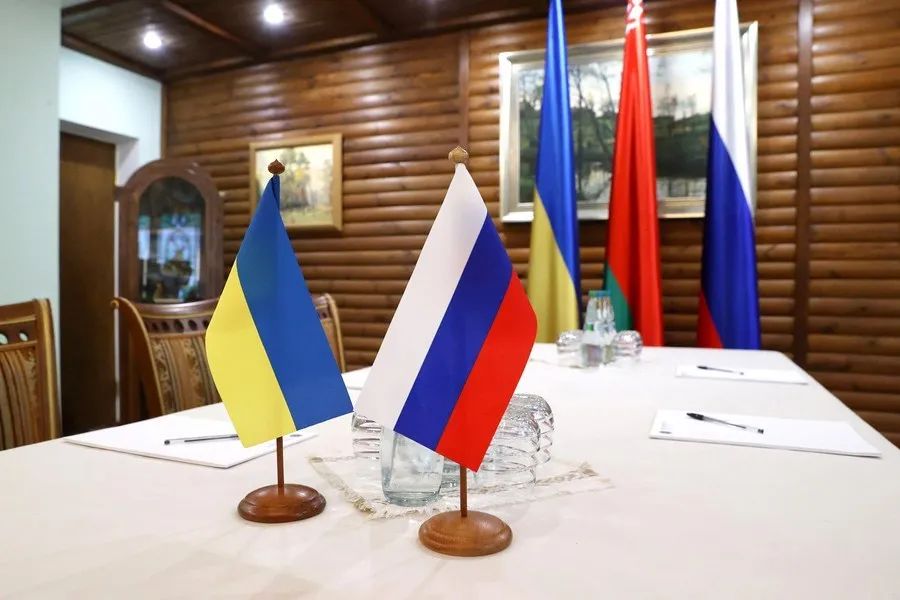
Photo taken on March 7, 2022 shows a view of the third round of talks between Russian and Ukrainian delegations at the Belovezhskaya Pushcha. [PhotoXinhua]
Amid refugee crisis, Beijing slams using smaller nations as pawns in confrontation
Although many politicians in Washington have avoided describing the Ukraine crisis as a de facto proxy war, Leon Panetta, the former US secretary of defense during the administration of president Barack Obama, recently did not hold back I think we are engaged in a conflict here. It's a proxy war with Russia, whether we say so or not. That, effectively, is what's going on.
And for that reason, we've got to make sure we are providing as much weaponry as possible, he told Bloomberg TV in an interview on March 18.
Amid the crisis, Beijing has publicly lashed out at Washington and its NATO allies for fueling a proxy war by offering weapons, missiles and fighter jets to Ukraine and stoking tension.
Behind China's decadeslong opposition to proxy wars is the belief that such a typical Cold War era tool seriously sabotages a country's autonomy, officials and scholars said.
Proxy wars were typical during the Cold War to help avoid direct warfare between the US and the former Soviet Union, and a smaller nation grilled on the forefront of conflicts is always the biggest loser with refugee crises soaring, they added.
A proxy war, like color revolution, serves to shore up a potential new Cold War and brings only turmoil and suffering to a region, said Zuo Xiying, a professor at the School of International Studies of Renmin University of China.
Washington decided to wage a proxy war in Ukraine partly because its plan to intimidate Russia by reinforcing military deployment in Eastern Europe countries actually had failed, Zuo said.
History shows that a smaller nation — chosen as a proxy and caught between two major countries — is always going to be the one suffering the largest damage from conflicts, Zuo said.
Before the Ukraine crisis broke out, the US and some of its NATO allies had publicly encouraged Ukraine to join NATO, started providing weaponry to the country and fanned the current tension, analysts said.
A fact sheet released by the US Department of Defense on Thursday said the security assistance the Biden Administration is providing to Ukraine is enabling critical success on the battlefield.
The release incorporates a long list of US military aid committed to Ukraine, including over 1,400 Stinger anti-aircraft systems and over 50 million rounds of ammunition.
Ukraine's fall from a central gateway of the Eurasian region to the forefront of major countries' conflict was prompted by a string of factors, but it is undoubtable that the only major factor is the external forces' reaching their hands too far, said Cui Hongjian, director of the European studies department at the China Institute of International Studies.
When the US determined to manipulate Ukraine as a pawn for geopolitical confrontation with Russia, it was no longer possible for Ukraine to maintain its balance in diplomacy, Cui added.
Vice-Foreign Minister Le Yucheng has criticized some major countries because they do not want to get dragged into conflicts and make empty promises to small countries, turn small countries into their pawn and even use them to fight proxy wars.
A NATO commitment of no eastward expansion could have easily ended the crisis and stopped the suffering. Instead, (they) chose to fan the flames at a safe distance, Le said in an address at a symposium on March 19.
Speaking of the refugee crisis, the G7 foreign ministers said in a joint statement on Thursday that over 4.2 million crossed the border to other countries, almost all of them to the EU and the Republic of Moldova.
Now that Ukraine has suffered as a proxy, the US and NATO will be even more deplorable and immoral if they continue offering weaponry to Ukraine and make the nation suffer at the forefront for any longer, said Wu Xinbo, dean of the Institute of International Studies at Fudan University.
Washington and NATO are the initiators of this crisis, and its resolution requires their engagement with Russia, not scorching Ukraine, Wu said.
'Extremely worried'
Anatol Lieven, a senior research fellow at the Quincy Institute for Responsible Statecraft, a US think tank, and a former foreign affairs correspondent, said he is extremely worried about the proxy war that disregards the number of Ukrainian lives — like Afghan lives in the past — that were thrown away in the course of this struggle.
It's quite clear that there are elements in both Washington and London who do want to use this as Afghanistan was used in order to weaken Russia eventually, he said in an MSNBC television broadcast on March 24.
In sharp contrast to the US, China's consistent objection to waging proxy wars stems from its decades-old core diplomatic belief of no intervention in other country's internal affairs, not to mention allowing other countries to meddle in China's domestic affairs, observers said.
More than 30 years after the end of the Cold War, such a geopolitical tragedy taking place in Europe now deserves our profound reflection, Zhang Jun, China's permanent representative to the United Nations, said at a UN Security Council briefing on Ukraine on Tuesday.
Small and medium-sized countries should not be pushed to the forefront of confrontation between great powers. All countries have the right to decide their foreign policy independently, and should not be forced to take sides, he said.
China has never engaged in proxy wars nor sought the so-called spheres of influence, and it opposes power politics and bloc confrontation, State Councilor and Foreign Minister Wang Yi told Gambian Foreign Minister Mamadou Tangara in Islamabad, Pakistan, on March 23.
China stands for equality among all countries regardless of their size, and it advocates democratization of international relations, Wang added.
Another reason behind Beijing's high alert against Washington's frequently waging of proxy wars worldwide is that a potential proxy war is what some hawkish individuals and groups back in the US are expecting to take place in China's neighborhood, said Yuan Zheng, deputy director of the Institute of American Studies of the Chinese Academy of Social Sciences.
Choosing Ukraine as a proxy to receive massive military assistance and stoking conflict with another major country are not new tactics, as the US and some of its NATO allies have been doing similar things in the Asia-Pacific region as well, Yuan said.
Washington has not given up any chance to motivate its allies in this region to confront and contain China, as it keeps sending military consultants, helping to train their troops, deploying missile systems and speaking out loud on issues involving China's core interests, Yuan said.
【背景阅读】
挑动俄乌冲突的煽风点火者——乱局背后的美国“黑手”
俄乌冲突演变至今,是多种因素共同作用的结果。不过,复杂的历史经纬中不难看到一条清晰脉络,冲突爆发的根源在于冷战结束后美国长期围堵和挤压俄罗斯的安全空间。
从历史看,美国一方面持续推进北约东扩,不断挑战俄安全“红线”;一方面在乌策动“颜色革命”,搅乱乌政局,破坏俄乌关系。从现实看,自去年俄乌关系持续紧张以来,美国不断煽风点火、火上浇油,推动危机一步步升级。若论俄乌冲突“始作俑者”,非美国莫属。
推动北约东扩
20世纪90年代苏联解体后,美国打着“巩固民主”“延伸稳定、推进共同价值观”等幌子,不断推进北约东扩。自1999年以来,北约五次东扩,其东部边界向前推进了1000多公里。现阶段,北约已经拥有30个成员国。按照2018年的统计数据,北约各国防务开支之和占全球各国防务支出总额的约七成,远远高于俄罗斯的军费支出。
美国总统拜登上台后,对俄立场强硬,增加对乌克兰的外交和安全支持,还支持乌克兰加入北约。这无疑触及了俄方的安全“红线”。
分析人士认为,美国主导下的北约在冷战结束后持续东扩,全然不顾俄罗斯的安全关切,最终把俄方“逼到墙角”。俄乌冲突正是俄美矛盾激化、俄方对美反击的具体表现。
美国国际问题专家托马斯·弗里德曼日前发表文章指出,美国关于“北约东扩”的重大决策失误导致与俄方关系恶化,美政府应该承担相当大的责任,“美国与北约都不是无辜的旁观者”。
无论是北约东扩,还是俄乌冲突,美国军火商都从中受益。曾在美国国防部长办公室工作多年的富兰克林·斯平尼认为,美国军工复合体应对俄乌冲突爆发负责,因为军工复合体的利益追逐及其游说活动导致冷战后北约一再违反不再东扩的承诺。美国军工复合体的利益决定美国需要敌人,因此它总有动力在全球寻找新的敌人。
策动“颜色革命”
乌克兰1991年独立后,原本与西方和俄罗斯保持着相对平衡的关系。2004年和2014年,乌克兰先后发生“橙色革命”和“广场革命”,国内族群严重对立,社会撕裂难以弥合,俄乌矛盾一步步升级。
不少线索表明,两场“颜色革命”背后都有美国的身影。美联社2004年末曾披露一批资料,证明美国曾插手乌克兰2004年选举,包括资助多个政治组织,为反对派领导人访美埋单等。2013年至2014年基辅独立广场发生骚乱时,美国时任助理国务卿维多利亚·纽兰和时任参议员约翰·麦凯恩直接前往独立广场,对反对派表达支持。
莫斯科国立大学政治学系教授安德烈·马诺伊洛认为,“颜色革命”是美国人开发的一项政治战术。涉事国当局最初往往看不出这是政变的开始,发现时则为时已晚。一旦政变发生,“颜色革命”组织者安插的人顺势上台掌权,令国家失去主权、受到外国监护人控制并为外国利益服务。
2014年,乌克兰时任总统亚努科维奇在“广场革命”中被迫下台,亲西方政府在乌克兰掌权。2019年2月,乌克兰议会通过宪法修正案,把乌克兰加入欧盟和北约作为国家基本方针写入宪法。
蓄意挑动对立
分析人士认为,美国长期以来试图在乌克兰制造一种“可控的动荡”。自去年年底以来,拜登政府不断煽动俄乌局势升级,一方面是着眼于今年下半年的美国中期选举,希望在外交领域为自己加分;另一方面意在加剧欧俄对立,进而迫使欧洲对美依赖增强,巩固美国的霸权地位。
因此,在俄乌局势高度紧张之际,美国不但没有寻求缓和危机,反而不断向乌克兰提供各种经济、军事援助,为乌方打气、对俄方挑衅。去年12月,美国政府批准向乌追加价值2亿美元安全援助。今年1月,北约决定向东欧成员国增派部队、军舰和战机。2月2日,美国宣布将向德国、波兰和罗马尼亚总计部署3000名军人。
在与美国及其盟友的多轮外交接触中,俄罗斯明确提出自己的安全诉求,包括不吸纳乌克兰为北约成员国、不在俄罗斯边境附近部署进攻性武器等,结果遭到美国和北约的无视,最终导致冲突爆发。
美国前国会众议员图尔西·加巴德说,拜登政府原本只要保证不接纳乌克兰加入北约,就可以结束危机,阻止冲突爆发,但他们偏不这样做。
来源新华社